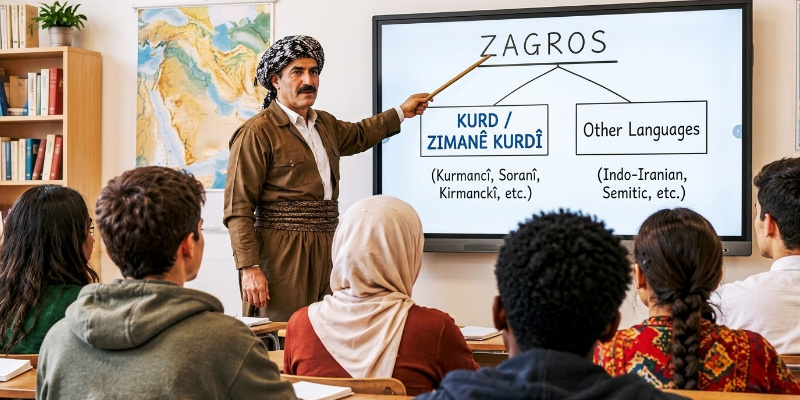
An observer’s note: Perhaps we overlooked a truth.
I want to ask a question that has been asked throughout history: Did the Kurds really come from Iran or India? Linguistic and genetic data show that this claim is not as solid as we think. Perhaps mainstream classification does not fully do justice to geography and history.
Linguistic Evidence: Kurdish Languages Are Not a “Dialect” of Persian
The difference between Kurdish languages and Persian is not a “dialect difference” but a structural one. These differences show that the two languages are not two branches of the same family, but separate branches.
Fundamental Structural Differences Between Kurdish Languages (Kurmanji and Sorani) and Persian
| Feature | Kurmanji | Sorani | Persian |
|---|---|---|---|
| Ergativity | Exists (in transitive verbs in the past tense) | Exists (in transitive verbs in the past tense) | Absent (completely lost) |
| Grammatical Gender | Exists (masculine/feminine) | Exists (masculine/feminine, though partially weakened) | Absent |
| Case Marking | Partially preserved | Partially preserved | Completely lost |
| Verb Prefixes | Rich system (da-, ve-, ra-) | Rich system (da-, ve-, ra-) | Largely lost |
This table alone shows the following: If Kurdish languages were a “sub-branch” of Persian, they would have lost the structures that Persian lost. But they have not. Preserving points to an older layer than losing.
The “Conservative” and “Innovative” Difference Between Mountain and Plain Languages
| Language | Ergativity | Grammatical Gender | Location |
|---|---|---|---|
| Kurmanji | Preserved | Preserved | Zagros (mountainous) |
| Sorani | Preserved | Preserved (partially) | Zagros (mountainous) |
| Kirmancki (Zazaki) | Preserved | Preserved | Zagros (mountainous) |
| Persian | Lost | Lost | Plain (imperial center) |
| Pashto | Preserved | Preserved | Mountainous |
| Balochi | Preserved | Partially | Mountainous/desert |
This table confirms the principle that “languages in mountainous regions preserve archaic features.” Zagros, in this sense, is a language reserve.
Critical Academic Support
The following statement in the Cambridge History of the Kurds is the strongest foundation of the thesis:
“The Kurdish languages do not have a direct genealogical relationship with any of the known Old and Middle Iranian period languages.“
That is, the Kurdish languages (Kurmanji, Sorani, Kirmancki), are not the direct continuation of either Old Persian or Middle Persian (Pahlavi). They are a parallel branch.
Archaeogenetic Evidence: Zagros Is Not a Refuge, But a Center
Ancient DNA (aDNA) studies show that Zagros Neolithic farmers were genetically distinct from Anatolian Neolithic populations, and that this component is represented at a high rate in modern Kurdish populations. Furthermore, this genetic component has a sphere of influence extending to Indo populations.
Genetic Legacy of Zagros Neolithic Farmers
| Population | Zagros Neolithic Component |
|---|---|
| Modern Kurds | Represented at a high rate |
| Modern Indo populations | Carries the Zagros Neolithic component |
| Modern Iranians | Represented (but lower) |
These data show the following: Zagros is not only a “refuge”; it is also a “center of diffusion.” The Kurds are the autochthonous people of this center. They are not “later arrivals”; they are the people who were already there.
Hurrian Substrate: The Invisible Foundation of Kurdish Languages
The archaic structures of Kurdish languages (ergativity, gender, verb prefixes) cannot be explained solely as “Indo-European heritage.” Some of these structures may have come from the pre-Indo-European linguistic layers of Zagros (Hurrian, Lullubian, Gutian).
Recent studies reveal the interaction of Kurdish languages (Kurmanji, Sorani, Kirmancki) with ancient Zagros languages such as Hurrian and Lullubian, and that this interaction created a distinctive morpho-phonological layer in Kurdish languages. Some research even shows continuity between Hurrian and Kurdish languages at the level of mythology and oral literature.
This means the following: Kurdish languages are the heirs of the autochthonous linguistic layers of Zagros. To see them as a sub-branch of Indo-European is to ignore this autochthonous heritage.
A New Model Proposal: The Zagros-Mesopotamian Language Family
The current “Indo-Iranian” model sees Zagros as a sub-branch. However, the data show that Zagros is a center. Therefore, I propose a two-tiered model:
Zagros-Mesopotamian Language Family (Proposal)
- ZAGROS-MESOPOTAMIAN LANGUAGE FAMILY
- KURDISH BRANCH (Remained in Zagros, preserved archaic features)
- Kurmanji
- Sorani
- Kirmancki (Zazaki)
- INDO-EUROPEAN BRANCH (Spread from Zagros, lost archaic features)
- Iranian Branch
- Indo Branch
- European Branch
- KURDISH BRANCH (Remained in Zagros, preserved archaic features)
The core claims of this model:
· The KURDISH Branch is not a sub-branch of Indo-European, but a sister branch originating from the same root.
· The Iranian, Indo, and European languages are not descendants of Kurdish, but cousins.
· The Kurdish Branch, by remaining in Zagros, preserved archaic features such as ergativity, grammatical gender, and verb prefixes.
· The Indo-European Branch lost these features as it spread from Zagros.
Comparison of the Current Model and the Proposed Model
| Current “Indo-Iranian” Model | Proposed “Zagros-Mesopotamian” Model | |
|---|---|---|
| Position of Kurdish languages | Sub-branch of Indo-Iranian (Northwestern Iranian) | Central branch of Zagros-Mesopotamian (KURDISH) |
| Relationship with Persian | Sister language (same sub-family) | Cousin language (different main branch) |
| Role of Zagros | Periphery (linguistic border region) | Center (cradle of linguistic diffusion) |
| Origin of the Kurds | Community arriving with Indo-European migrations | Autochthonous Neolithic farmers of Zagros |
The Same Fallacy in 2026: Wikipedia’s Definition and the Reality
It is 2026. Genetics and archaeology have long shown that the Kurds are the autochthonous people of Zagros. Yet there are still those who think the Kurds are a people “who came from Hindustan” and Kurdish languages are “a dialect of Persian.” There is only one reason for this: Incorrect language family classification. And the most visible source of this fallacy is the world’s most consulted encyclopedia: Wikipedia.
Wikipedia’s Definition
Wikipedia’s “Kurdish languages” article begins with undisputed certainty:
“The Kurdish languages or Kurdish (Kurdish: Kurdî), belonging to the Western Iranian branch of the Indo-Iranian languages of the Indo-European language family, is a language branch spoken by Kurds living in eastern and southeastern Turkey, northern Syria, northern and northeastern Iraq, and western Iran.”
Wikipedia’s “Kurds” article draws a similar framework: Kurds are defined as a people “speaking Indo-European languages” and “of Iranian origin.”
Why Is This Definition Misleading?
This definition contains a contradictory statement within itself. Wikipedia’s “Kurdish languages” page makes the following admission in the same paragraph:
“Although Kurdish is generally classified within Northwestern Iranian languages, it carries many features belonging to the Southwestern Iranian branch that are not found in the Northwestern Iranian branch, and with its Northern, Central, and Southern dialects, it is positioned as a dialect continuum situated between Northwestern Iranian and Southwestern Iranian languages.”
So even Wikipedia admits that Kurdish languages (Kurmanji, Sorani, Kirmancki) do not fit into “a single Iranian branch” but are a transitional zone squeezed between two branches. Yet it still does not refrain from placing it in the “Western Iranian branch of Indo-Iranian.”
What Does the Reality Say?
However, the data we present in this article show the following:
· Linguistics: Kurdish languages (Kurmanji, Sorani, Kirmancki) have preserved the ergativity and grammatical gender that Persian lost. This makes them not a “sub-branch” of Persian, but a sister branch.
· Genetics: The genetic legacy of Zagros Neolithic farmers is represented at a high rate in modern Kurds. This makes them not “later arrivals” but autochthonous.
· Archaeology: Shanidar shows the uninterrupted settlement memory of Zagros.
Wikipedia’s definition, ignoring these three data points, repeats the 19th-century “Indo-Iranian” template. And this template establishes the “Kurd = Iranian” equation in the minds of millions. KURD ≠ Iranian
Conclusion: A Call to Scientists
I see the following: Linguistic and genetic data show that the current paradigm is not as consistent as it is thought to be.
· Genetics says the Kurds are the autochthonous people of Zagros.
· Linguistics says Kurdish languages (Kurmanji, Sorani, Kirmancki) are not the direct continuation of known Old/Middle Iranian languages.
· Archaeology shows the uninterrupted settlement memory of Zagros (Shanidar).
· Hurrian substrate studies reveal the connection of Kurdish languages with autochthonous Zagros layers.
When these four data points come together, the following question becomes inevitable: Why are Kurdish languages still classified under the “Indo-Iranian” umbrella?
Perhaps the answer is simple: Because the classification is based on the geographical and political assumptions of the 19th century. And those assumptions ignore Zagros.
This article is not a claim, but an invitation: Let us discuss a new model that places Zagros at the center. Perhaps we really did overlook something.
Thanks.