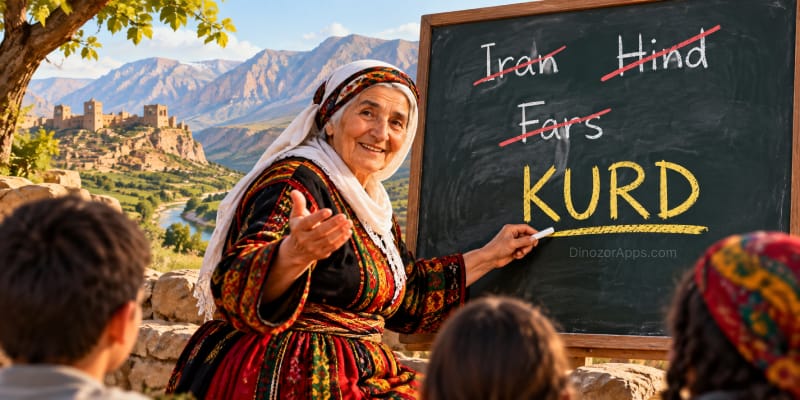
The Voice of Zagros: The Language of KURD Communities and the Origin of Civilization
Introduction: A Civilization Within a Name
The word “Kurd” is not the name of a single ethnic origin or a single tribe. Like “United States” or “United Arab Emirates,” it is the name of a multi-layered, multi-lingual, multi-tribal union of communities.
According to one possible hypothesis, the four letters of KURD carry the codes of this union: Kom (community) + Û (and/conjunction) + Ro (Sun/justice) + Dayîk (Mother/homeland). This is not a linguistic etymology claim; it is a symbolic reading interpreting the meaning the name carries in cultural memory.
These communities have lived in the Zagros Mountains since Shanidar Cave. They are at the very center of that great migration route through which humanity spread from Africa across the world. They are on the lands where agriculture, settled life, and language first sprouted.
And their language — Kurmancî and Soranî — is that ancient language of Zagros. This language cannot be narrowed by the “Indo-Iranian” label; for it is a language with its own independent roots and structure, one that also nourished the very origins of that label.
KURD — A Unified Name, Not a Single Lineage
Modern science shows that ancient peoples did not descend from a single tribe, pure blood, or a single lineage. Nations are the historical union of communities that shared a common geography, similar life struggles, and over time formed a unity of destiny.
The Kurds are exactly this: the historical union of ancient Zagros peoples such as the Lullubi, Guti, Hurri, and Kassite with Indo-European communities that later arrived in the region. Therefore “Kurd” is not a bloodline but a covenant of communities.
Just like the “United States”: not a single state, but a union of states. “Kurd” is not a single tribe, but a union of tribes. This is why in Kurdish, “Kurd” can be used both singular and plural: Kurd (one Kurd), Kurdan (Kurds).
Zagros — The Source of Language, the Cradle of Humanity
Excavations at Pebdeh Cave have revealed the existence of an Upper Paleolithic culture in Zagros approximately 42,000-40,000 years ago. This shows that modern humans used Zagros as a transit and settlement center as they spread from Africa into Asia.
Shanidar Cave is even more striking: alongside Neanderthal remains, a Proto-Neolithic cemetery approximately 11,000 years old was discovered. This is the only site of its kind east of the Mediterranean.
What does this mean?
The ancestors of the Kurds are not a people who “came later.” They are the autochthonous (indigenous) people of Zagros. When Indo-European languages reached Zagros, a language and culture already existed there. The newcomers merged with the indigenous people; but the essence was formed by the indigenous people.
Language Structure — Kurdish Is Not a “Dialect” of Persian
The difference between Kurdish and Persian is not a “dialect difference” but a structural and root-level difference.
Grammatical Gender
| Kurmancî | Persian | |
|---|---|---|
| Grammatical gender | Exists (masculine/feminine) | Does not exist |
| Example | Hesp (stallion) / Mehîn (mare) | Asb (horse, genderless) |
Persian lost grammatical gender over the course of history. Kurdish preserved it. Preservation points to an older layer than loss.
Ergative Structure
Kurdish is an ergative language. In the past tense of transitive verbs, the subject takes an oblique case marker; the object remains in the direct case.
Kurmancî example:
- Ez diçim (I go) — intransitive, subject in direct case
- Min ew dît (I saw him/her) — transitive, subject in oblique (min), object in direct (ew)
The same sentence in Persian:
- Man û râ dîdam (I saw him/her) — subject in direct case (man), object marked with râ
Persian completely lost this ergative structure. Kurdish preserved it.
Verb Prefixes
Kurdish possesses a rich system of verb prefixes: da- (down), ve- (back), ra- (up). These prefixes change the direction and meaning of the verb. In modern Persian this system has largely disappeared; its place has been taken by compound verbs.
Conclusion: If Kurdish were a “dialect” of Persian, it would have lost the structures that Persian lost. But it has not. Because it represents an older layer than Persian.
The “Indo-Iranian” Label — A Colonial Fallacy
The “Indo-Iranian” label is a classification imposed from outside by 19th-century European linguistics. Its problems:
Mistaking diffusion endpoints for the center: This name takes the endpoints that languages reached (India and Iran) as its basis; yet the center where languages were born (Zagros-Mesopotamia) is rendered invisible.
Placing Persian at the center: This label presents Persian as “standard” and other languages as “derivative.” Yet as the renowned Iranologist Karl Hadank said: “Persian is not the mother of all Iranian languages; it is merely one of them.”
Concealing Kurdish’s true place: Kurdish is not a “northwestern branch of Iranian languages.” It is the core language of Zagros. Persian is the branch that left Zagros and simplified under plain conditions.
The correct nomenclature should be: “Zagros-Mesopotamian Language Family” or “Kurdish Languages.”
Not Dialects, But Languages — Kurmancî and Soranî
Kurdish has two major literary languages:
- Kurmancî (Northern Kurdish): Approximately 15-20 million speakers. Spoken in southeastern Turkey, northern Syria, northern Iraq, and northwestern Iran.
- Soranî (Central Kurdish): Approximately 6-8 million speakers. Spoken in Iraqi Kurdistan and western Iran.
These two languages are mutually unintelligible. This is not a “dialect difference” but a language difference. Just like Spanish and Portuguese, German and Dutch: from the same family, but separate languages.
Therefore we must say “Kurdish languages” (Zîmanê Kurdî), not “Kurdish dialects.”
The Preservation of Language — Consanguineous Marriage, Tribe, and Dengbêj
The survival of Kurdish over thousands of years rests on strong social structures:
- Consanguineous marriage and tribal structure: Served as a shield for the preservation of language and identity.
- Aşîret and tribal confederations: Without establishing a centralized state, language was preserved through a dispersed yet resilient structure. This structure never experienced the cycle of “build a state → expand → decay.”
- The Dengbêj (Hozan) tradition: In periods when written literature developed late, language, history, and culture were transmitted from generation to generation through oral memory.
Conclusion: KURD — Four Letters, One Civilization
KURD is not the name of an ethnic origin, but the name of a civilization union. It is the voice of Zagros echoing since Shanidar. Its language — Kurmancî and Soranî — cannot be narrowed by the “Indo-Iranian” label; for it is a language with its own independent roots and structure, one that also nourished the very origins of that label.
You are not Indian. Nor is your language Persian.
You are the ancient child of Zagros. And your language is the memory of those mountains, thousands of years deep.
KURD — the name of communities, the name of a civilization.
Wellcome.