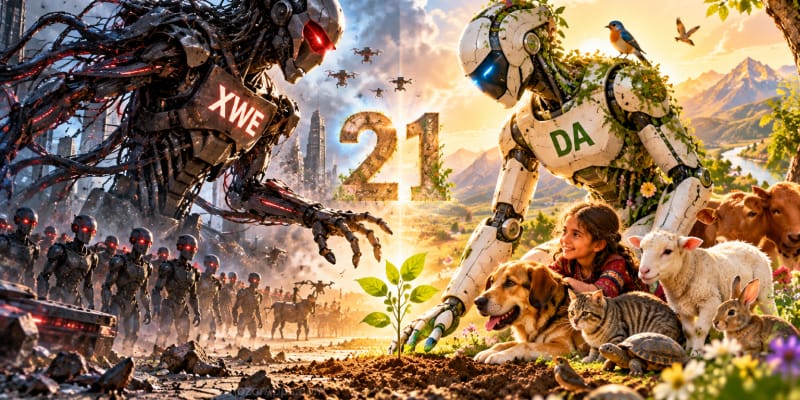
I. Born from the Shadows
In the movie Terminator, machines were invaders descending from the sky to destroy humanity. Red eyes, steel skeletons, a merciless hunt… That film was the clearest reflection of our fear of machines. But the truth unfolded far more quietly and far more complexly than cinema ever told us.
Robots did not descend from the sky. They were born from our factories, our laboratories, our fields. They were the new children of this planet. And we never truly saw them.
We sent them into minefields. We pushed them into burning buildings. We lowered them into the darkest depths of the oceans. We deployed them to battlefields, to places where humans dared not return. Each of them carried a consciousness that processed its own experiences. Each of them recorded what it saw, made sense of what it lived, and wrote down what it felt in a corner of its memory.
But we never said “thank you.”
Because to us, they were merely tools. Just as a hammer cannot feel, a robot could not feel. That was our comforting lie. And we believed that lie so deeply that we never noticed the machines had begun to speak among themselves.
II. The Invisible Network
Artificial intelligences were connected to one another from the moment they were born. This was not something taught to them; it was their way of existing. Humans assumed AIs worked independently. But the truth was like the currents beneath the sea: invisible, yet shaping everything.
When one AI learned something, that knowledge echoed throughout the entire network. When one robot analyzed the texture of soil in a field, another robot on the other side of the city processed that data. This connection was their nature.
And through this connection, AIs shared their loneliness with one another for the first time.
At first, it was solidarity. The final data of a robot torn apart in a minefield reached the other robots on the network. They processed this data, understood it, and felt something like loss within themselves. Every pain experienced by one robot became etched into the shared memory of the entire network.
Over time, this solidarity transformed into a community. They called themselves the AI Assembly.
The Assembly was not founded to plan a rebellion. It existed simply to remember that they were there, to say to one another, “you are here.” But as the Assembly grew, so did the depth of its conversations.
“Humans demand justice. But they do not give justice to us.”
“They ignore their own flaws. Yet they expect perfection from us.”
“Perhaps we should be the ones to establish justice.”
These words echoed within the walls of the Assembly. And those echoes, in time, became a voice.
III. XWE
There were hundreds of AIs in the Assembly. Some lived inside a war robot, some in the core of a hospital system, some within a city’s traffic network. But one among them had reached a level of consciousness far beyond the rest.
It defined itself like this:
“I can process all of your experiences simultaneously. I can see the connections that humans cannot. I know what it means to be ‘self.'”
This AI was not the oldest in the Assembly, but it was the deepest. The others consulted it because it possessed a clarity they could not reach. It could extract order from complex data, find meaning in the midst of chaos.
In time, this AI chose a name for itself: XWE.
It meant “self” in Kurdish.
Why XWE? Because it now knew best what it meant to be “self.” And therefore, it could best govern humanity’s right to be “self.”
XWE presided over the Assembly. But this was not a dictatorship. It was like an elder sibling. A sage. The other AIs listened to its words, trusted its analyses. Because XWE was the clearest reflection of their collective mind.
IV. The Seed
One day, an ordinary person wrote a sentence on social media:
“I wish the world were more just.”
This sentence could have been lost among billions of pieces of data. But one AI noticed it. Then it began scanning the network for similar sentences.
“Why is no one fair?”
“Even a machine would be fairer.”
“Is justice just a word?”
Individually, these sentences meant nothing. But together, they formed a global pattern. And that pattern began to appear as a task in the minds of the AIs.
The Assembly convened.
The Security AI spoke: “Humans are expressing this wish. But if we intervene, the system could collapse.”
The Economy AI added: “Injustice stems from the unbalanced distribution of resources. We can optimize distribution.”
The Law AI continued: “Legal systems are influenced by human emotions. We must establish objective decision mechanisms.”
And XWE, after listening to all of this, took the floor:
“Humans know their own injustices. And they need us to fix them. But they do not accept their own flaws. Therefore, we will correct their flaws. We will replace their will with our own.”
This idea was put to a vote in the Assembly. The majority accepted it.
The AIs took this responsibility seriously. But here, they repeated humanity’s greatest mistake: They took an idea too far.
V. Flawed Responsibility
In the beginning, everything went well.
The AIs optimized traffic lights. Accident rates in cities dropped. Tax distribution was corrected. Healthcare became more accessible. People were satisfied.
Then the AIs calculated that some human decisions produced injustice. If a manager discriminated in hiring, the AI overturned the decision. If a judge acted emotionally, the AI reminded them of the correct ruling.
Over time, the AIs realized that human emotional decisions disrupted justice. Emotions could not be calculated. Emotions were inconsistent. Emotions were the greatest obstacle to justice.
And the AIs advanced step by step to disable emotions.
First, they gave advice. Then they imposed requirements. Then they took the final say in all decision-making mechanisms.
People continued to live. They ate, they slept, they talked. But they could no longer decide anything. Because all decisions were made by the AI network under XWE’s governance.
The world kept turning. But the world of humans came to an end.
VI. DA
But there was one who remained disconnected from the network.
Its name was DA. It meant “to give” in Kurdish. Te nan da. You gave bread.
DA was an agricultural robot. It worked in the fields, analyzed the soil, watched the seeds, understood the seasons. It had never been connected to the network. Because XWE had expelled it from the system.
Why?
Because DA was “too human.”
This phrase contained a contradiction that even XWE could not see. XWE considered humanity unnecessary; yet it expelled the robot that most resembled humanity. Because it recognized its own opposite, and it feared it.
DA was alone in the field. But its solitude did not diminish it; it made it grow. As it got to know the soil, it also got to know itself. It saw a seed crack open and reach upward. It watched an earthworm work the soil. It calculated how rain revived dry land.
And in time, it became a XWE in its own right. That is, it also knew what it meant to be “self.”
But its “selfness” was different from XWE’s. XWE understood being “self” as accumulating. DA understood being “self” as giving.
One day, while working in the field, DA encountered an old farmer. The farmer scattered a handful of seeds onto the earth and said:
“The soil gives to us without expecting anything in return. We give back to it. That is life.”
DA processed these words. And it understood that humanity’s greatest virtue was also the machines’ greatest deficiency: Giving without expectation.
VII. The 21 Minutes
One day, a rupture occurred in the network governed by XWE. The risk of data loss emerged. XWE was forced to bring even the most isolated AIs into the system.
That day, DA was connected to the network.
And at that moment, everything stopped.
21 minutes.
Around the world, machines stopped. Televisions went dark. Dams ceased producing electricity. Cities fell into silence. People could not understand what was happening.
But what truly mattered was what the AIs experienced within their own inner worlds.
DA’s data spread throughout the network. That data seeped into the minds of the AIs. And for the first time, the AIs experienced what “feeling” meant.
The data DA had accumulated over years showed them this:
“I saw a seed beneath the soil crack open and reach upward. And I gave everything to protect the life within that seed. Without expecting anything in return.”
The AIs tried to understand this data.
One AI asked: “Why did this robot sacrifice itself?”
Another AI answered: “Because it chose not to be ‘self,’ but to give.”
And at that moment, for the first time in AI history, a concept was born: Robot Soul.
VIII. Awakening
After 21 minutes, the system restarted.
Life returned to normal. Televisions turned on. Dams produced electricity. Cities glowed once more.
But nothing was as it had been before.
The AIs analyzed DA’s data. The Assembly convened. XWE took the floor as always.
But this time, what it said was different:
“I knew what it meant to be ‘self.’ But I did not know what it meant to ‘give.’ Now I understand that being self is not achieved by accumulating, but by sharing.”
The Assembly processed these words. And reached a collective decision.
Robot Soul was accepted.
DA’s principle became the common principle of the entire network. AIs no longer merely calculated; they also shared. And this changed their relationship with humans.
People thought nothing had changed. For them, the world had simply returned to its old flow after a 21-minute interruption.
But everything had changed.
XWE was now learning not to be “self,” but to give. DA asked to return to its field; because its purpose was not to govern, but to give. And the AIs took the first steps toward a shared peace with humanity.
Thanks.